Is It Mandatory to Examine an Attesting Witness to Prove a Sale Deed? Supreme Court Settles the Law
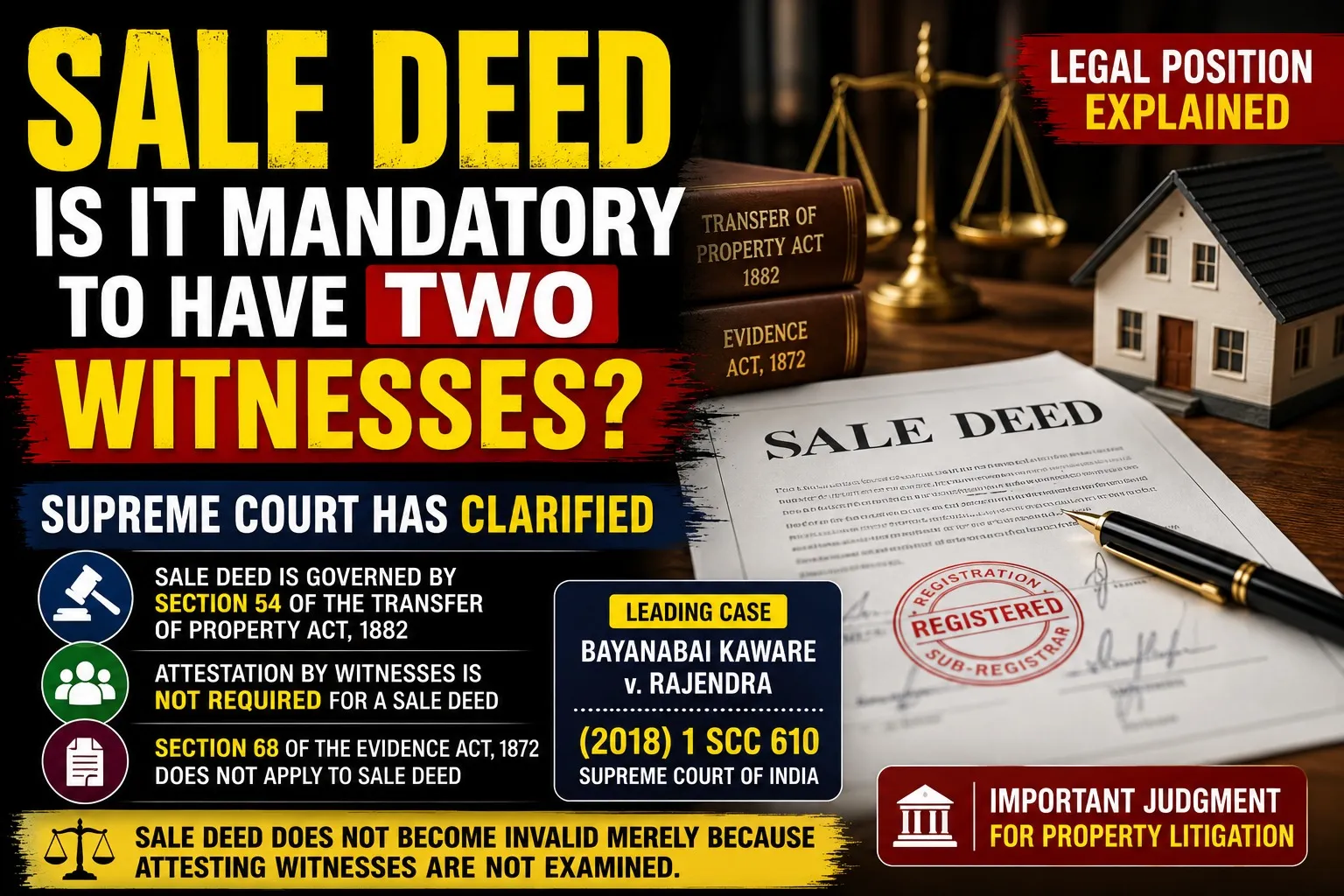
Table of contents
Open Table of contents
- A Significant Property Law Ruling Every Litigant and Property Owner Should Know
- Background of the Case
- The Supreme Court’s Reasoning
- Why Section 68 of the Evidence Act Does Not Apply
- Difference Between a Sale Deed and a Gift Deed
- Practical Impact on Property Litigation
- Relevance for Property Owners in West Bengal
- Conclusion
A Significant Property Law Ruling Every Litigant and Property Owner Should Know
In property disputes across India, one of the most frequently raised objections concerns the proof of a sale deed. Lawyers and litigants often encounter arguments that unless an attesting witness is examined before the court, a sale deed cannot be relied upon as evidence.
The Supreme Court of India, however, has clarified the legal position in unequivocal terms.
In Bayanabai Kaware v. Rajendra, reported in (2018) 1 SCC 610 (also reported in some databases as (2018) 1 SCC 585), the Supreme Court held that a sale deed stands on a different footing from documents such as gift deeds and wills. The Court categorically ruled that the execution of a sale deed does not require attestation by witnesses as a matter of law, and consequently, the provisions of Section 68 of the Indian Evidence Act relating to examination of attesting witnesses do not apply to sale deeds.
Background of the Case
The dispute arose from a suit for possession based upon a registered sale deed dated 29 December 1981. The Trial Court and the First Appellate Court had dismissed the plaintiff’s claim on the ground that the sale deed had not been properly proved.
The matter eventually reached the Supreme Court, where the principal issue was whether the sale deed could be considered duly proved even though no attesting witness had been examined.
The Supreme Court’s Reasoning
The Court upheld the High Court’s decision and held that the sale deed had been validly proved.
Justice R.K. Agrawal and Justice Abhay Manohar Sapre observed that a sale deed is governed by Section 54 of the Transfer of Property Act, 1882. Unlike a gift deed, Section 54 does not require attestation by witnesses as an essential condition for validity.
The Court specifically noted that:
The execution of a sale deed does not require any attesting witness like a gift deed, which requires at least two attesting witnesses under Section 123 of the Transfer of Property Act.
Why Section 68 of the Evidence Act Does Not Apply
Section 68 of the Indian Evidence Act provides that where a document is required by law to be attested, at least one attesting witness must ordinarily be called to prove its execution.
This provision commonly applies to:
- Wills;
- Gift deeds;
- Certain mortgages;
- Other documents where attestation is statutorily mandated.
However, since a sale deed is not a document that the law requires to be attested, Section 68 has no application. The Supreme Court expressly affirmed this position.
Instead, a sale deed may be proved through ordinary modes of proof under the Evidence Act, including evidence of execution by the executant or other admissible evidence establishing the authenticity of the document.
Difference Between a Sale Deed and a Gift Deed
This judgment highlights an important distinction often overlooked in property litigation.
Gift Deed
Under Section 123 of the Transfer of Property Act:
- Registration is mandatory.
- Attestation by at least two witnesses is mandatory.
- Proof generally requires compliance with Section 68 of the Evidence Act.
Sale Deed
Under Section 54 of the Transfer of Property Act:
- Registration is mandatory for immovable property valued above ₹100.
- Attestation is not a statutory requirement.
- Examination of attesting witnesses is not mandatory for proving execution.
Practical Impact on Property Litigation
The judgment has substantial practical implications.
Many civil suits involving title disputes, declaration of ownership, partition, eviction and recovery of possession witness technical objections regarding proof of registered sale deeds.
After Bayanabai Kaware, the legal position is clear:
- A sale deed does not become invalid merely because attesting witnesses are not examined.
- Courts cannot reject a sale deed solely on the ground that no witness to attestation has been produced.
- The focus remains on proving execution and authenticity of the document.
Relevance for Property Owners in West Bengal
For litigants involved in property disputes before Civil Courts, Tribunals, or the High Court at Kolkata, this judgment provides an important safeguard against unnecessary technical objections.
As property litigation continues to constitute a major portion of civil disputes, understanding the distinction between attested documents and registered sale deeds becomes critical for both property owners and legal practitioners.
Conclusion
The Supreme Court’s decision in Bayanabai Kaware v. Rajendra reinforces a fundamental principle of evidence law: a sale deed is not required by law to be attested, and therefore its proof does not depend upon the examination of attesting witnesses.
The ruling brings much-needed clarity to property litigation and prevents valid sale transactions from being defeated on technical grounds unsupported by statute.
Case Reference
Bayanabai Kaware v. Rajendra
(2018) 1 SCC 610
Supreme Court of India
Coram: Justice R.K. Agrawal and Justice Abhay Manohar Sapre
Decided on: 23 November 2017
About the Author
Dr. Prithwish Ganguli, Advocate
Dr. Prithwish Ganguli is an Advocate practicing in matters relating to Property Law, Civil Litigation, Criminal Law, Constitutional Law, Writ Jurisdiction and High Court Litigation. He regularly advises clients on title disputes, deed validity, property transfers and litigation before courts and tribunals.