Clicked a Question Paper, Shared it on WhatsApp: Is It a Privacy Violation? Gujarat High Court Draws the Line
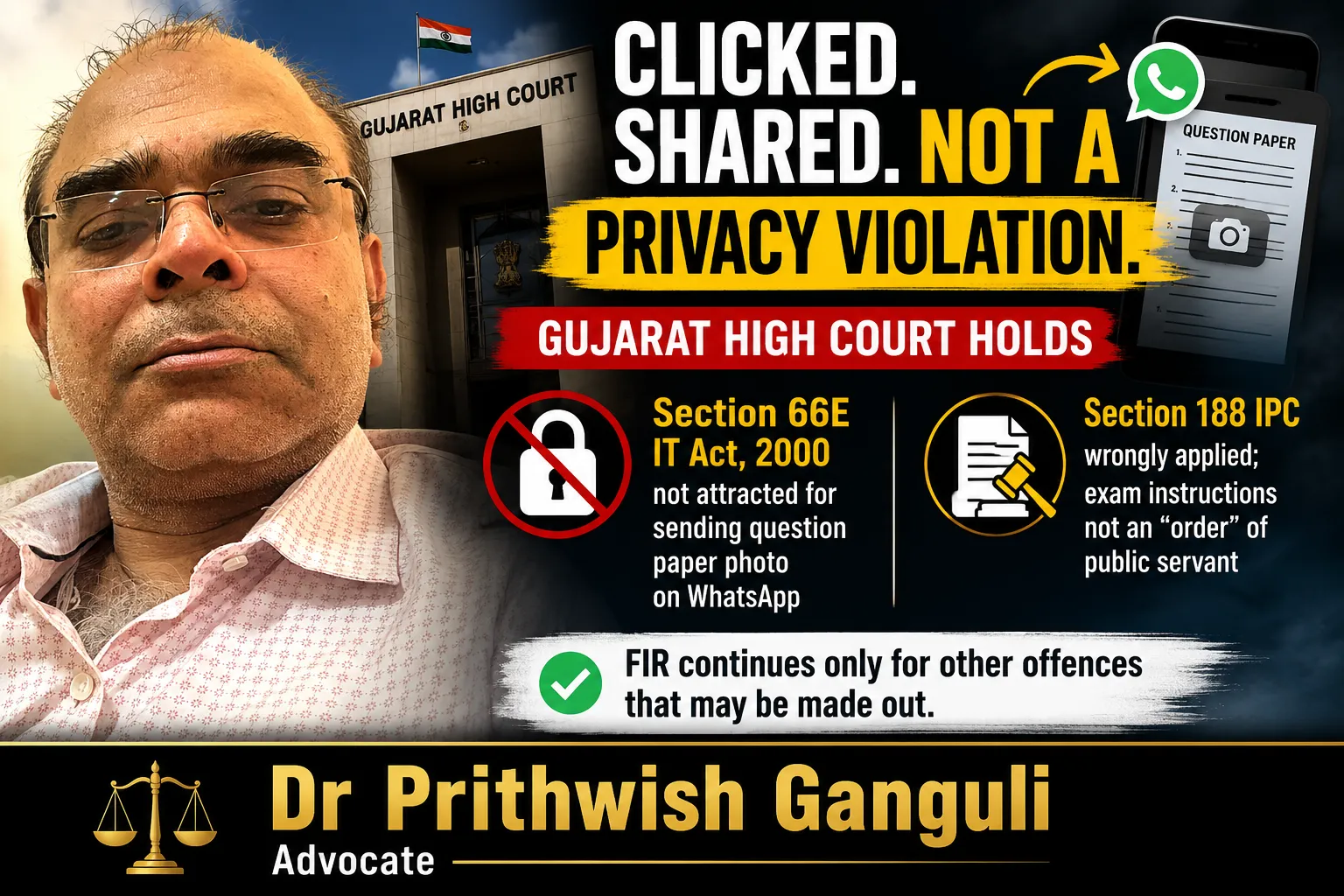
Table of contents
Open Table of contents
- Gujarat High Court Clarifies the Scope of Privacy Law in the Digital Age
- What Exactly Happened?
- Is a Question Paper a “Private Area” Under Section 66E?
- Why This Decision Matters Beyond Examination Cases
- Section 188 IPC Also Failed Judicial Scrutiny
- The Procedural Defect That Could Not Be Ignored
- The State Itself Conceded the Point
- Did the Accused Get Complete Relief?
- The Larger Legal Lesson for Lawyers, Students and Investigators
- Privacy Law and Digital Communication: A Necessary Distinction
- Conclusion
Gujarat High Court Clarifies the Scope of Privacy Law in the Digital Age
Can a student be prosecuted for violating privacy merely because he photographed an examination question paper and sent it through WhatsApp?
The Gujarat High Court has recently answered this important question in the negative, delivering a significant ruling that reinforces a fundamental principle of criminal jurisprudence: criminal liability cannot be imposed unless every ingredient of the offence is clearly established.
In Rahul Babulal Purohit & Anr. v. State of Gujarat & Anr., the Court examined whether sending a photograph of an examination question paper through WhatsApp could attract Section 66E of the Information Technology Act, 2000, a provision designed to protect individuals from violations of privacy involving intimate images.
The ruling serves as an important reminder that courts cannot stretch criminal statutes beyond their intended purpose merely because the conduct in question appears improper or unethical.
What Exactly Happened?
A Mobile Phone Inside the Examination Hall Triggered Criminal Proceedings
The case originated from an incident during a public examination. According to the prosecution, an invigilator noticed that a candidate was using a mobile phone inside the examination hall. Upon inspection, it was allegedly discovered that the candidate had photographed the question paper and transmitted the images through WhatsApp to his brother outside the examination centre.
Based on this allegation, an FIR came to be registered against the candidate and his brother.
Among various provisions, the investigating agency invoked:
- Section 66E of the Information Technology Act, 2000;
- Section 188 of the Indian Penal Code;
- Other provisions that remained subject to investigation.
The accused subsequently approached the Gujarat High Court seeking quashing of the proceedings.
Is a Question Paper a “Private Area” Under Section 66E?
The Court’s Straightforward Answer: No
Section 66E of the Information Technology Act criminalizes the intentional capture, publication, or transmission of images of the private area of any person without consent.
The legislative objective behind Section 66E is clear. It is intended to protect bodily privacy and prevent the circulation of intimate or private images.
The Court noted that what was allegedly transmitted in the present case was not an image of any person’s private body part. It was merely a photograph of an examination question paper.
Therefore, the essential ingredients of Section 66E were completely absent.
The Court observed that sending a photograph of a question paper through WhatsApp cannot be equated with:
- Capturing a private image of a person;
- Publishing an intimate photograph;
- Violating bodily privacy;
- Transmitting images of a private area.
Since the foundational requirement of the offence was missing, the provision could not legally apply.
Why This Decision Matters Beyond Examination Cases
Courts Cannot Expand Criminal Statutes Through Interpretation
One of the most significant aspects of the judgment is its reaffirmation of a settled principle of criminal law.
Criminal statutes must be interpreted strictly. Courts cannot create offences through expansive interpretation. Likewise, investigating agencies cannot invoke penal provisions merely because a person’s conduct appears suspicious, undesirable, or morally questionable.
The question is not whether the conduct was proper. The question is whether the conduct satisfies the legal ingredients of a specific offence. If the ingredients are absent, prosecution under that provision cannot continue.
This principle lies at the heart of constitutional criminal jurisprudence in India.
Section 188 IPC Also Failed Judicial Scrutiny
Are Examination Instructions Equivalent to a Legal Order?
The prosecution had also invoked Section 188 IPC, which deals with disobedience of an order duly promulgated by a public servant.
The Court carefully examined this aspect.
Every examination centre issues instructions to candidates. Common examples include:
- Do not carry mobile phones;
- Do not communicate with outsiders;
- Do not use unfair means;
- Do not leave the hall without permission.
However, the Court clarified that these instructions cannot automatically be treated as a legally promulgated order under Section 188 IPC.
The distinction is crucial. A breach of examination rules may result in:
- Cancellation of examination;
- Debarment;
- Academic penalties;
- Administrative consequences.
But every violation of examination rules does not automatically become a criminal offence under Section 188 IPC.
The Procedural Defect That Could Not Be Ignored
Criminal Law Requires Compliance with Mandatory Procedures
The Court also highlighted another important legal issue.
Even if Section 188 IPC were hypothetically attracted, the law requires a written complaint from the competent public servant before a court can take cognizance of the offence.
This requirement exists under Section 195 of the Code of Criminal Procedure (now reflected in the Bharatiya Nagarik Suraksha Sanhita framework).
In the present case, that statutory requirement was not fulfilled. Consequently, the prosecution under Section 188 IPC suffered from a fundamental legal defect.
The State Itself Conceded the Point
A Rare Moment of Agreement in Criminal Litigation
Interestingly, the State Prosecutor agreed before the Court that:
- Section 66E of the IT Act was not attracted;
- Section 188 IPC was also not sustainable.
The Court recorded this concession and proceeded to quash the proceedings to that extent. Such concessions are relatively uncommon in criminal litigation and indicate that the legal position was difficult to defend.
Did the Accused Get Complete Relief?
Absolutely Not
A common misconception after reading headlines about quashing orders is that the entire criminal case has ended.
That is not what happened here.
The Gujarat High Court specifically clarified that the FIR would continue regarding any other offences that may be disclosed from the facts and evidence collected during investigation.
The Court merely removed those provisions whose ingredients were demonstrably absent. Therefore, if the investigation reveals commission of any other legally sustainable offence, proceedings may continue in accordance with law.
The Larger Legal Lesson for Lawyers, Students and Investigators
Wrong Conduct Does Not Automatically Mean Every Penal Provision Applies
This judgment carries lessons far beyond examination malpractice. In contemporary criminal practice, it is increasingly common to see multiple penal provisions added at the FIR stage.
However, every section added to an FIR must independently satisfy its statutory ingredients.
The Gujarat High Court’s ruling reminds us that:
- Criminal law cannot operate on assumptions.
- Penal provisions cannot be stretched to fit facts.
- Courts must guard against over-criminalization.
- Investigations must remain statute-specific.
- Liberty cannot be curtailed through creative interpretation of criminal provisions.
Privacy Law and Digital Communication: A Necessary Distinction
Not Every Digital Transmission Is a Privacy Violation
In an era dominated by smartphones, WhatsApp, social media and instant communication, privacy-related prosecutions are becoming increasingly common.
Yet privacy law has defined boundaries. Merely because a photograph is transmitted electronically does not mean there has been a violation of privacy.
The nature of the image matters. The context matters. The statutory language matters.
The Gujarat High Court’s decision reinforces that Section 66E is designed to protect personal bodily privacy and not every form of digital image transmission.
Conclusion
The Rule of Law Begins with the Ingredients of the Offence
The Gujarat High Court’s decision serves as a timely reminder that criminal law is governed by statutory ingredients, not public perception.
The conduct alleged in the case may have raised concerns relating to examination integrity. However, concerns regarding examination misconduct cannot justify invocation of provisions that were never intended to address such conduct.
The judgment ultimately strengthens the rule of law by reaffirming a simple but powerful principle: No person can be prosecuted under a penal provision unless every constituent element of that offence is clearly established. That principle remains one of the strongest safeguards against arbitrary criminal prosecution in India.
About the Author
Dr. Prithwish Ganguli, Advocate
Dr. Prithwish Ganguli is an Advocate practicing before various Courts and Tribunals with interests in Criminal Law, Constitutional Law, Cyber Law, Digital Evidence, White-Collar Crime, Citizenship Matters, Immigration Law, Writ Jurisdiction and Complex Litigation. He regularly writes on contemporary legal developments, landmark judgments, criminal procedure, digital privacy, cyber offences and emerging issues in Indian law.