Can a Court Compel Mediation in a Mutual Consent Divorce? Calcutta High Court Answers
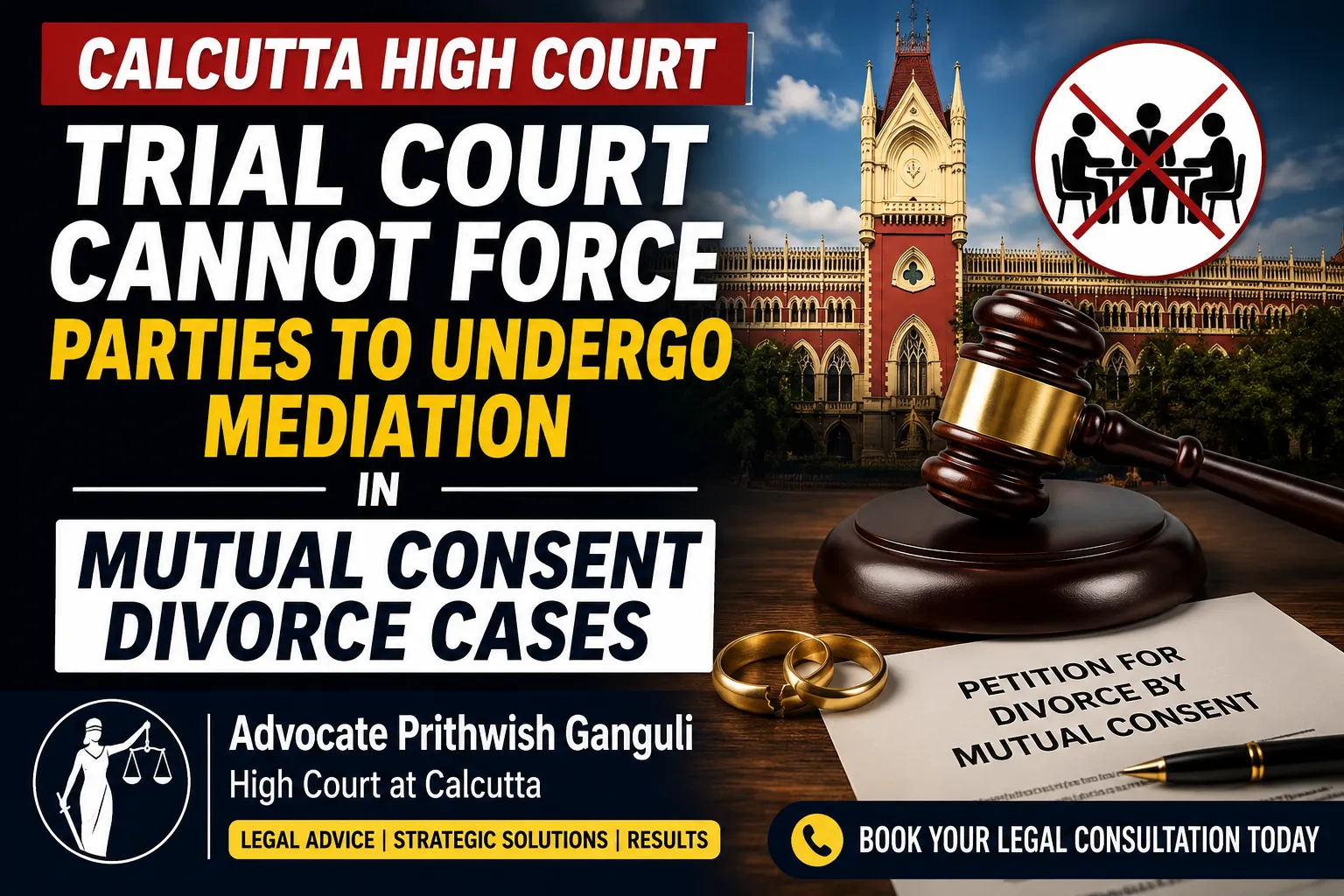
Table of contents
Open Table of contents
Introduction
Divorce by mutual consent is intended to provide couples with a dignified and efficient legal process when both spouses have independently decided that their marriage has irretrievably broken down. In a significant judgment, the Calcutta High Court has reaffirmed that a Trial Court cannot compel parties to participate in mediation against their wishes in a mutual consent divorce proceeding. This decision is an important development in Indian family law and offers much-needed clarity for couples seeking an amicable separation.
If you are searching for a divorce lawyer in Kolkata, understanding the legal implications of this judgment can help you navigate the process more effectively. At the office of Advocate Prithwish Ganguli, we regularly advise clients on mutual consent divorce, contested divorce, child custody, maintenance, and other matrimonial disputes before the High Court at Calcutta and Family Courts across West Bengal.
Background of the Case
The case, Danish Karim v. Ranjana Chowdhury (F.A.T. 22 of 2026), arose from an order passed by the Additional District Judge, First Court at Sealdah. The parties had jointly filed a petition for divorce by mutual consent under Section 28 of the Special Marriage Act, 1954.
Instead of proceeding with the statutory process, the Trial Court directed the parties to appear before a mediator. When they did not participate in mediation, the Trial Court dismissed the joint divorce petition solely on that ground.
Aggrieved by the dismissal, both spouses approached the Calcutta High Court seeking appropriate relief.
What Did the Calcutta High Court Hold?
A Division Bench comprising Justice Sabyasachi Bhattacharyya and Justice Supratim Bhattacharya categorically held that mediation cannot be forced upon parties who have jointly sought dissolution of their marriage.
The Court observed:
“The consent of both parties to go for mediation is a sine qua non for referring the matter to mediation and the parties cannot be forced against their will to go to mediation.”
The Bench explained that although Section 89 of the Code of Civil Procedure permits courts to refer disputes for mediation, such reference is based on the willingness of the parties. Mediation is a consensual dispute resolution mechanism—not a compulsory procedural requirement.
Why Is This Judgment Important?
The judgment draws a clear distinction between:
- Contested matrimonial disputes, where mediation may help resolve differences; and
- Mutual consent divorce proceedings, where both spouses have already agreed to end the marriage.
When parties have consciously and voluntarily decided to dissolve their marriage, compelling them to undergo mediation only delays the statutory process without serving any meaningful legal purpose.
The High Court further criticised the Trial Court’s approach, describing it as a “palpable misconception of law” and “absolutely perverse and contrary to basic legal tenets.”
This observation reinforces that courts must apply the law in accordance with the legislative framework rather than creating additional procedural hurdles.
Understanding Mutual Consent Divorce Under Indian Law
A mutual consent divorce is one where both husband and wife jointly approach the court seeking dissolution of their marriage. Unlike a contested divorce, there is no dispute regarding the decision to separate.
Under the Special Marriage Act, 1954, as well as the Hindu Marriage Act, 1955, certain statutory requirements must be fulfilled before the court grants a decree of divorce by mutual consent. These include:
- Mutual agreement to dissolve the marriage.
- Statutory period of separation, where applicable.
- Free and voluntary consent of both spouses.
- Settlement of issues relating to maintenance, alimony, child custody, and other ancillary matters.
The court’s role is to ensure that the statutory conditions are satisfied. It is not to compel reconciliation where both parties have unequivocally expressed their intention to separate.
Is Mediation Mandatory in Divorce Cases?
This is one of the most common questions clients ask during an online legal consultation.
The answer depends on the nature of the dispute. In contested matrimonial disputes involving allegations, custody issues, or financial disagreements, courts may encourage mediation as an alternative dispute resolution mechanism.
However, this judgment makes it clear that mediation cannot be imposed in every case. Where the parties have already settled all disputes and jointly filed for mutual consent divorce, forcing them into mediation defeats the very objective of an amicable and expeditious legal process.
Practical Impact of the Judgment
This decision has several practical implications:
- Trial Courts cannot dismiss mutual consent divorce petitions merely because parties refuse mediation.
- Mediation remains voluntary and cannot be made compulsory.
- Courts must follow the procedure prescribed under the Special Marriage Act.
- Mutual consent divorce proceedings should not be unnecessarily delayed.
- The autonomy and informed decision of both spouses must be respected.
The ruling is likely to reduce unnecessary procedural delays in matrimonial proceedings and ensure that couples receive timely justice.
Why Professional Legal Advice Matters
Although mutual consent divorce is generally simpler than a contested divorce, every case presents unique legal and practical considerations.
Issues relating to:
- Permanent alimony,
- Child custody,
- Visitation rights,
- Division of assets,
- Settlement agreements, and
- Drafting of consent terms
must be carefully addressed before filing the petition. A properly drafted settlement significantly reduces the possibility of future disputes.
Whether you are considering a mutual consent divorce, facing a contested divorce, or require advice on maintenance, child custody, or other family law issues, obtaining guidance from an experienced family lawyer in Kolkata is essential.
Conclusion
The Calcutta High Court’s decision in Danish Karim v. Ranjana Chowdhury is a welcome reaffirmation of the principle that mediation is a voluntary process and cannot be forced upon parties seeking a mutual consent divorce.
By setting aside the Trial Court’s order, the High Court has clarified that courts must adhere to the statutory framework and respect the informed decision of spouses who have mutually agreed to dissolve their marriage. The judgment promotes judicial efficiency, protects individual autonomy, and strengthens the legal foundation governing mutual consent divorce in India.
Advocate Prithwish Ganguli
As an experienced divorce lawyer in Kolkata, Advocate Prithwish Ganguli regularly advises clients in matters involving:
- Mutual Consent Divorce
- Contested Divorce
- Family Court Litigation
- Child Custody and Guardianship
- Maintenance and Alimony
- Domestic Violence Proceedings
- Matrimonial Disputes
- Proceedings under the Special Marriage Act
- Proceedings under the Hindu Marriage Act
- Appeals before the High Court at Calcutta
Every matrimonial dispute requires a practical strategy, careful legal drafting, and a thorough understanding of family law. Early legal advice often helps parties avoid unnecessary litigation and procedural complications. If you are looking for an advocate in Kolkata for divorce or matrimonial matters, professional legal consultation can help you understand your rights, evaluate your legal options, and ensure that the proceedings are conducted in accordance with law.