Supreme Court on Mediated Settlements, Domestic Violence Proceedings and Article 142: Key Legal Principles from Dhananjay Rathi v. Ruchika Rathi
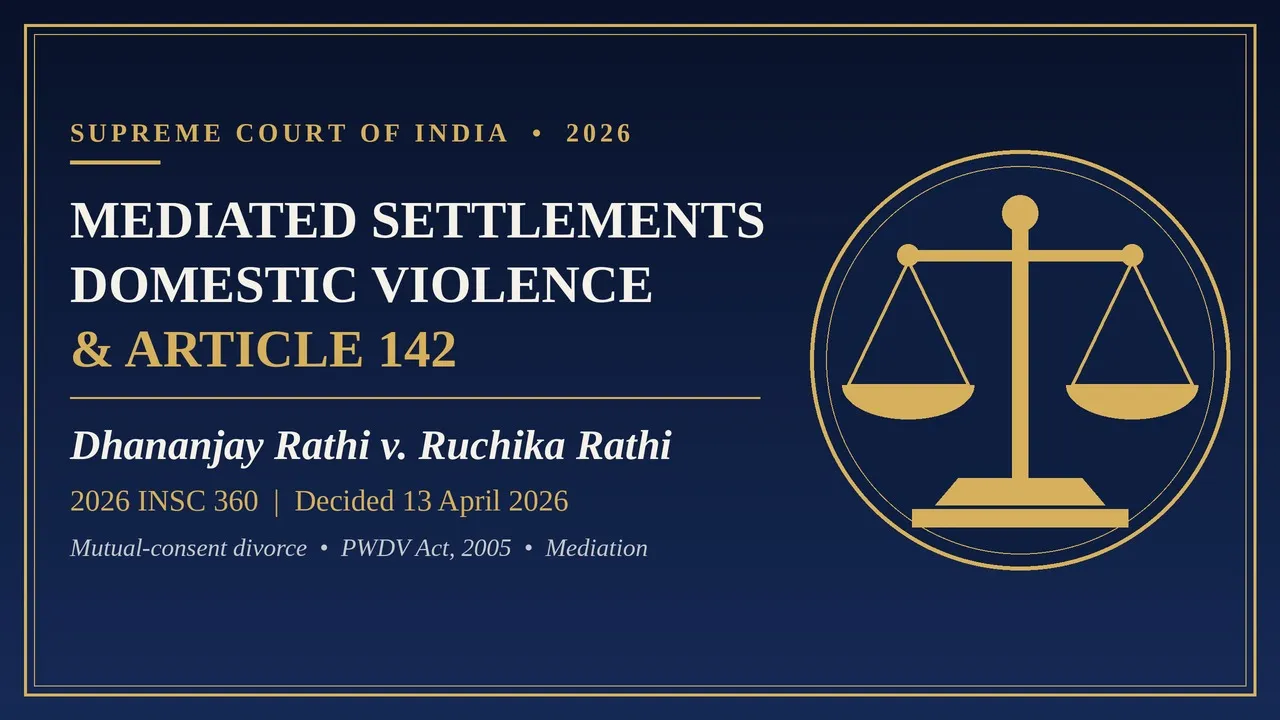
Table of contents
Open Table of contents
- Executive Summary
- Background of the Case
- Questions Considered by the Supreme Court
- 1. Effect of a Settlement Reached Through Mediation
- 2. Withdrawal of Consent Under Section 13B and Mediated Settlement
- 3. Importance of Precise Drafting of Settlement Agreements
- 4. Proceedings Under the Domestic Violence Act: Specific Allegations Are Necessary
- 5. Criminal Proceedings Cannot Be Permitted to Become an Extension of Matrimonial Conflict
- 6. Article 142 and Irretrievable Breakdown of Marriage
- 7. Irretrievable Breakdown Is a Factual Determination
- 8. Article 142 Jurisdiction Is Situation-Specific
- 9. Holistic Assessment of the Matrimonial Relationship
- 10. Application of Article 142 in the Present Case
- 11. Practical Implications for Matrimonial Litigation
- Conclusion
Executive Summary
Dhananjay Rathi v. Ruchika Rathi, 2026 INSC 360, is a significant Supreme Court judgment concerning the legal effect of a mediated matrimonial settlement, withdrawal of consent to mutual divorce, proceedings under the Protection of Women from Domestic Violence Act, 2005, and the Supreme Court’s power under Article 142 of the Constitution. The judgment was delivered on 13 April 2026 in Criminal Appeal No. 1924 of 2026.
The parties were married in 2000 and had two children. Following matrimonial disputes, they began living separately in 2022–23. The husband instituted divorce proceedings under the Hindu Marriage Act, 1955. The Family Court subsequently referred the matter to mediation, resulting in a detailed Settlement Agreement dated 16 May 2024. The parties agreed to dissolve their marriage by mutual consent, settle their financial claims, transfer certain assets, return jewellery, and discontinue further civil or criminal proceedings arising from their matrimonial dispute.
Pursuant to the settlement, the first motion for divorce by mutual consent was allowed. The husband made substantial payments and complied with other obligations, while the wife also performed obligations contemplated by the settlement. Subsequently, however, the wife withdrew her consent to the second motion and instituted proceedings under Section 12 of the Domestic Violence Act against the husband and his mother. The husband approached the Supreme Court seeking, among other reliefs, quashing of the DV proceedings and dissolution of the marriage under Article 142.
The Supreme Court examined the legal significance of the mediated settlement and the circumstances in which a party could resile from such an agreement. It considered the competing contentions concerning alleged assurances relating to jewellery and other property that were not expressly incorporated into the written settlement. The Court also examined whether continuation of the Domestic Violence Act proceedings, in the circumstances of the case, constituted an abuse of the process of law.
A further and important issue before the Court was whether the matrimonial relationship had undergone an irretrievable breakdown warranting exercise of the Supreme Court’s constitutional power under Article 142(1). The Court considered the parties’ prolonged separation, the history of matrimonial litigation, the settlement and mediation proceedings, the allegations between the parties, and the circumstances indicating whether any realistic possibility of reconciliation remained.
The judgment therefore brings together important principles relating to mediation in matrimonial disputes, enforceability of settlement agreements, mutual-consent divorce under Section 13B of the Hindu Marriage Act, proceedings under the Domestic Violence Act, quashing of criminal proceedings, abuse of process, and Article 142 jurisdiction.
For practitioners, the decision also highlights the importance of precise drafting of matrimonial settlement agreements. Where parties intend a settlement to constitute a full and final resolution of their disputes, material financial, property, and other obligations should be clearly incorporated into the written agreement.
Background of the Case
The parties had been married since 2000 and had two children. Matrimonial disputes subsequently arose and the parties began living separately around 2022–23. The husband instituted divorce proceedings before the Family Court on allegations including cruelty and adultery.
The Family Court referred the matter to mediation. On 16 May 2024, the parties entered into a detailed Settlement Agreement covering their matrimonial and financial disputes. The settlement contemplated:
- Divorce by mutual consent under Sections 13B(1) and 13B(2) of the Hindu Marriage Act, 1955;
- Payment of a substantial settlement amount;
- Transfer of assets and other obligations; and
- An undertaking by both sides not to institute further civil or criminal proceedings concerning the matrimonial dispute.
The first motion for mutual-consent divorce was subsequently allowed. The husband made substantial payments and complied with other obligations under the settlement.
The wife later withdrew her consent to the second motion. Thereafter, she instituted proceedings under Section 12 of the Protection of Women from Domestic Violence Act, 2005, against the husband and his mother.
The matter eventually reached the Supreme Court.
Questions Considered by the Supreme Court
The Court identified three principal questions:
- Whether the proceedings under the Domestic Violence Act should be quashed.
- Whether a party can resile from a settlement agreement arrived at during mediation and, if so, in what circumstances.
- Whether the Supreme Court could exercise its power under Article 142(1) to dissolve the marriage on the ground of irretrievable breakdown and, if so, on what terms.
These questions make the judgment particularly significant for matrimonial lawyers because they bring together mediation law, matrimonial settlement, criminal proceedings, and constitutional divorce jurisdiction.
1. Effect of a Settlement Reached Through Mediation
One of the most important observations concerns the enforceability of a settlement reached through mediation.
The Supreme Court distinguished the present case from situations in which parties simply file a petition for divorce by mutual consent and subsequently withdraw consent before the second motion.
The Court noted that the settlement in the case before it had been arrived at through mediation pursuant to a court order and had subsequently been ratified by the Court.
The Court relied upon its earlier decision in Gimpex Private Limited v. Manoj Goel concerning the consequences of a settlement and observed that parties cannot ordinarily reverse the effect of a settlement by pursuing proceedings relating to the dispute that had already been settled.
When Can a Party Resile from a Mediated Settlement?
The Supreme Court identified an important qualification. A party may resile from a mediated settlement where it successfully establishes that the settlement was procured by:
- Fraud;
- Force; or
- Undue influence.
The Court also recognised non-fulfilment of a condition forming part of the settlement as a circumstance in which a party may have grounds to resile.
This distinction is important in legal practice. The judgment does not establish that every settlement automatically prevents withdrawal of consent to a mutual-consent divorce. Rather, it examines the legal consequences of a court-referred mediation settlement, particularly where substantial obligations under that settlement have already been performed.
2. Withdrawal of Consent Under Section 13B and Mediated Settlement
The judgment also discusses the established principle that consent for a mutual-consent divorce must continue until the decree is passed.
The Court considered authorities including Sureshta Devi v. Om Prakash, Hitesh Bhatnagar v. Deepa Bhatnagar, and Smruti Pahariya v. Sanjay Pahariya. It distinguished those authorities on the facts before it because the present settlement had been reached through mediation pursuant to court directions and had subsequently been ratified by the Court.
The Supreme Court further observed that the respondent had not established fraud, force, or undue influence in relation to the settlement.
Therefore, the judgment should be read carefully: withdrawal of consent to mutual divorce and resiling from a mediated settlement are related but legally distinct questions. That distinction is particularly important when drafting mediation settlements in matrimonial matters.
3. Importance of Precise Drafting of Settlement Agreements
The judgment contains an important practical lesson concerning settlement drafting.
The Court examined an allegation concerning jewellery and gold biscuits which, according to the respondent, had been promised to her. The Court noted that those alleged conditions were not incorporated into the written Settlement Agreement.
The Court also considered the fact that the respondent was represented by an advocate when the settlement was entered into.
For matrimonial practitioners, this highlights the critical importance of ensuring that a full and final settlement agreement records every material financial, property, maintenance, jewellery, custody, and procedural obligation clearly and exhaustively.
Key Takeaway: A settlement should not leave important financial or property arrangements to informal assurances, oral understandings, WhatsApp exchanges, or subsequent correspondence when the parties intend those matters to form part of the settlement.
4. Proceedings Under the Domestic Violence Act: Specific Allegations Are Necessary
The Supreme Court separately examined the Domestic Violence Act complaint.
The Court found that the complaint did not contain specific allegations describing acts of domestic violence committed by the husband or his mother. It observed that merely naming family members, without specific allegations indicating their active involvement in the alleged acts of violence, is insufficient in the circumstances considered by the Court.
The Court stated that a complaint of this nature, where there is merely reference to the names of family members without specific allegations pointing towards active involvement, should be stopped at the threshold.
This part of the judgment is relevant to applications seeking quashing of proceedings arising from matrimonial disputes, particularly where the pleadings do not disclose specific acts attributable to each individual proceeded against.
It is important, however, to understand this observation in the factual context of the case. The judgment does not say that every Domestic Violence Act complaint must satisfy an identical level of pleading or that every complaint involving relatives can be quashed merely because allegations are disputed.
5. Criminal Proceedings Cannot Be Permitted to Become an Extension of Matrimonial Conflict
The Supreme Court also cautioned against allowing emotional conflict arising from a matrimonial dispute to become the basis of criminal prosecution without adequate factual foundation.
The Court observed that emotional disputes should not be permitted to transform into criminal prosecution in circumstances where the legal ingredients necessary for such prosecution are absent. It connected such proceedings with the potential abuse of the process of law and harassment.
This reinforces the broader jurisdiction of constitutional courts to prevent criminal proceedings from continuing where the allegations, even taken at their face value, do not disclose the necessary legal foundation.
6. Article 142 and Irretrievable Breakdown of Marriage
The second major area of the judgment concerns Article 142(1) of the Constitution of India.
The Supreme Court reiterated that irretrievable breakdown of marriage is not itself a statutory ground of divorce under the Hindu Marriage Act. However, the Supreme Court has developed jurisprudence permitting it, in appropriate cases, to exercise its constitutional power under Article 142 to do complete justice.
The Court relied substantially upon the Constitution Bench decision in Shilpa Sailesh v. Varun Sreenivasan.
The relevant principle is that the Supreme Court may exercise Article 142 jurisdiction where there has been a complete and irretrievable breakdown of the marriage, but such power is discretionary and must be exercised with care and caution.
7. Irretrievable Breakdown Is a Factual Determination
The Court emphasised that irretrievable breakdown cannot simply be presumed from the existence of matrimonial litigation. It has to be factually determined by examining the circumstances cumulatively.
The factors identified in the judgment include:
- The period for which the parties lived together;
- When they last cohabited;
- The nature of allegations made against each other;
- Allegations concerning family members;
- Orders passed during litigation;
- The cumulative effect of litigation on the matrimonial relationship;
- Attempts at settlement;
- Mediation efforts;
- The timing and outcome of mediation;
- Length of separation;
- Financial and social circumstances;
- Circumstances concerning children;
- Custody and welfare of children;
- Maintenance and alimony;
- Economic rights of the parties and children; and
- Other pending proceedings.
The Court noted that a period of separation of six years or more is a relevant factor, while also making clear that these considerations are illustrative rather than an inflexible statutory checklist.
8. Article 142 Jurisdiction Is Situation-Specific
The Supreme Court reiterated that Article 142 cannot be reduced to a rigid formula.
The Court referred to Shilpa Sailesh and observed that the factors relevant to determining irretrievable breakdown are illustrative and that the jurisdiction is situation-specific.
This is significant because an extended period of separation, by itself, does not automatically produce a decree of divorce from the Supreme Court under Article 142. The Court must first be satisfied that the matrimonial relationship has completely and irretrievably broken down.
9. Holistic Assessment of the Matrimonial Relationship
The Court also referred to Rinku Baheti v. Sandesh Sharda.
In an Article 142 application, the Supreme Court may take a holistic view of the matrimonial relationship rather than treating the proceeding exactly like an ordinary fault-based divorce trial before a Family Court.
The judgment explains that the Supreme Court’s focus in exercising Article 142 jurisdiction is whether the marriage has irretrievably broken down and whether there remains any realistic scope for reconciliation. This represents an important distinction between an ordinary matrimonial trial and the Supreme Court’s constitutional jurisdiction to do complete justice.
10. Application of Article 142 in the Present Case
After examining the circumstances, the Supreme Court concluded that the matrimonial relationship between the parties had undergone a complete and irretrievable breakdown.
The Court noted the parties’ separation, the history of litigation, the settlement proceedings, and the absence of a realistic possibility of peaceful coexistence. It therefore considered the matter appropriate for exercise of Article 142(1).
The Court ultimately granted divorce under Article 142 and dealt with the financial and other consequences of the settlement in its final directions.
11. Practical Implications for Matrimonial Litigation
The judgment offers several practical lessons for advocates handling matrimonial disputes:
- Mediation settlements require precision: Every material term should be expressly incorporated into the written settlement agreement.
- Distinguish consent withdrawal vs. breach of settlement: Advocates should clearly distinguish between the right to withdraw consent under Section 13B and the consequences of breaching or attempting to resile from a broader mediated settlement.
- Record consequences of non-performance: Where a settlement has been partly performed, the agreement should clearly record the consequences of non-performance and the remedies available to the parties.
- Draft specific Domestic Violence Act pleadings: Pleadings in proceedings under the Protection of Women from Domestic Violence Act, 2005 should clearly identify the alleged acts, the persons responsible, and the factual circumstances relied upon.
- Build a comprehensive record for Article 142: In an Article 142 matter, advocates should place before the Supreme Court a comprehensive factual record covering duration of separation, previous proceedings, mediation attempts, financial arrangements, children, maintenance, property disputes, and the possibility or otherwise of reconciliation.
Conclusion
Dhananjay Rathi v. Ruchika Rathi, 2026 INSC 360, brings together three important areas of Indian matrimonial jurisprudence: the finality of court-referred mediation settlements, judicial scrutiny of domestic-violence proceedings, and the Supreme Court’s constitutional power under Article 142 in cases of irretrievable breakdown of marriage.
For advocates handling family and matrimonial litigation, the judgment is particularly relevant because it demonstrates how the Supreme Court may examine the entire litigation history rather than treating individual proceedings in isolation. At the same time, the decision reinforces the importance of carefully drafted settlements, specific pleadings, and a clear evidentiary record when seeking relief before the constitutional courts.
Primary Source:
Supreme Court of India, Dhananjay Rathi v. Ruchika Rathi, Criminal Appeal No. 1924 of 2026, judgment dated 13 April 2026, 2026 INSC 360.
Advocate Prithwish Ganguli
House # 73, near Tank #10, behind Matri Sadan Hospital,
EE Block, Sector II, Bidhannagar, Kolkata, West Bengal 700091
M.: 99030 16246