Live-In Relationships in India: Legal Recognition, Rights, and Judicial Trends
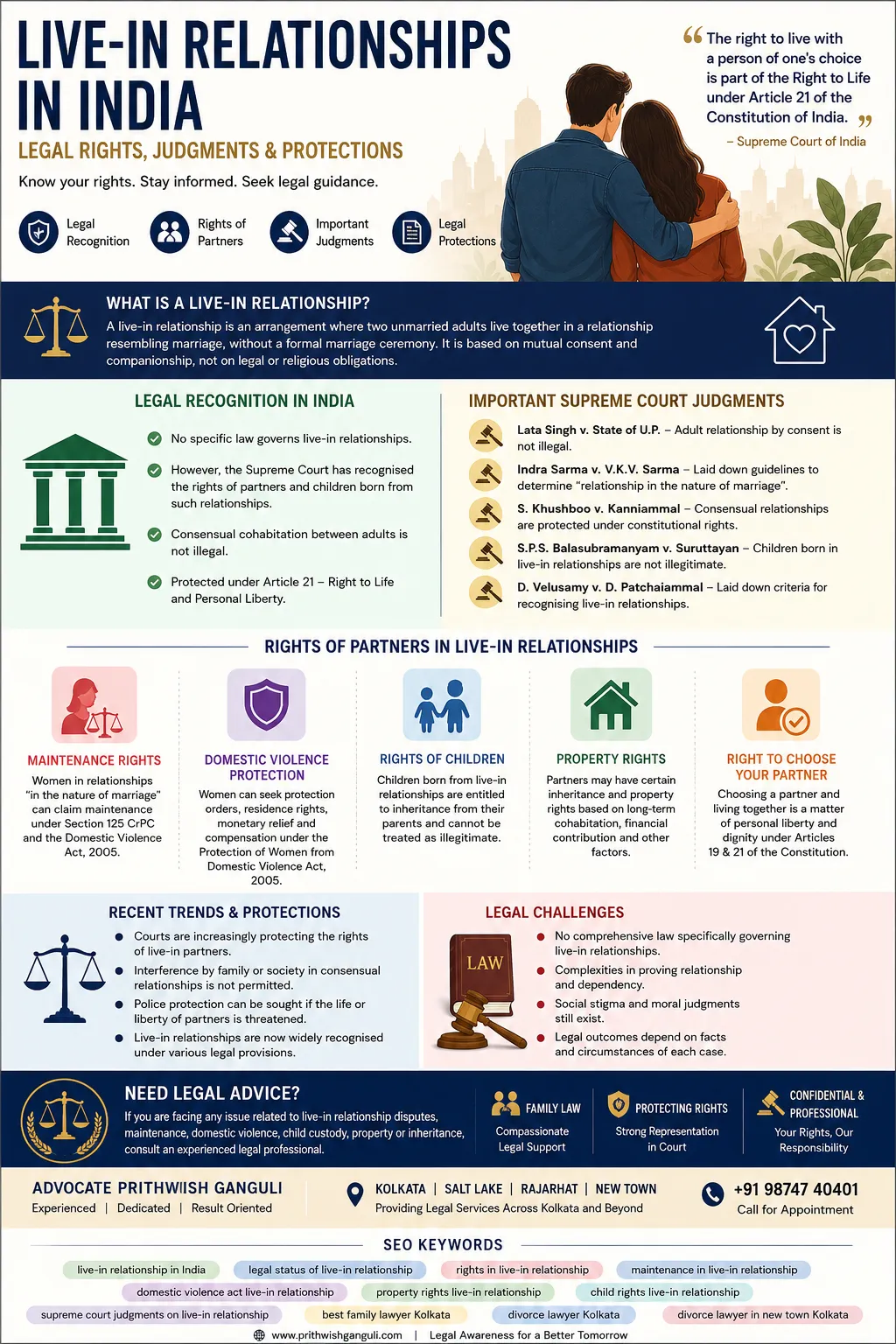
Table of contents
Open Table of contents
Introduction
With changing social realities and increasing judicial recognition of live-in relationships, consultations with a divorce lawyer in Kolkata have become far more common. As courts continue to expand legal protection for consenting adults in such relationships, the role of a competent family lawyer has become increasingly important in safeguarding the rights, dignity, and legal interests of individuals involved.
What is a Live-In Relationship?
A live-in relationship refers to an arrangement where two unmarried adults voluntarily reside together in a relationship resembling marriage without a formal ceremony.
The Supreme Court has repeatedly observed that living together is part of the fundamental right guaranteed under Article 21 of the Constitution of India. While it doesn’t automatically create traditional marital obligations, Indian courts recognise certain legal protections where the relationship resembles a marriage in substance.
Legal Recognition and Landmark Judgments
India does not have a dedicated legislation for live-in relationships, but judicial interpretation has filled this vacuum:
- Lata Singh v. State of U.P.: The Supreme Court held that while society may consider such relationships immoral, they are not illegal.
- Badri Prasad v. Deputy Director of Consolidation: Recognised that prolonged cohabitation creates a strong presumption of marriage.
- D. Velusamy v. D. Patchaiammal: Laid down the “nature of marriage” test, requiring the couple to hold themselves out to society as spouses and live in a shared household for a significant duration.
Rights and Protections
1. Maintenance Rights
One of the most significant protections is the right to maintenance. In Indra Sarma v. V.K.V. Sarma, the Supreme Court discussed when such relationships qualify for protection under the Protection of Women from Domestic Violence Act, 2005. A woman need not prove a formal marriage ceremony to seek maintenance if the relationship substantially resembles marriage.
2. Domestic Violence Protection
The 2005 Act recognises relationships “in the nature of marriage,” allowing women to seek:
- Protection orders and residence rights.
- Monetary relief and compensation.
- Maintenance.
3. Legitimacy and Rights of Children
Children born from long-term live-in relationships are protected by the law:
- S.P.S. Balasubramanyam v. Suruttayan: Held that such children should not be treated as illegitimate.
- Revanasiddappa v. Mallikarjun: Granted inheritance rights to children born from such relationships.
4. Property and Inheritance
While rights are not always absolute, courts consider cohabitation duration, public perception, and financial dependence when deciding inheritance claims in cases like Vidyadhari v. Sukhrana Bai.
Constitutional Framework
The freedom to choose a partner is part of individual liberty and dignity (Shafin Jahan v. Asokan K.M.). Landmark rulings in Joseph Shine and Navtej Singh Johar have further expanded constitutional privacy and autonomy rights, supporting the legality of personal relationship choices.
Conclusion
Live-in relationships are no longer outside the protection of Indian law. While no dedicated statute exists, judicial trends clearly favour protecting the rights of consenting adults. Whether you are dealing with maintenance proceedings, custody litigation, or domestic violence matters, seeking assistance from an experienced family lawyer in Kolkata is essential to safeguard your legal rights.
Advocate Prithwish Ganguli
House # 73, near Tank #10, (Behind Matri Sadan Hospital),
EE Block, Sector II, Bidhannagar (Salt Lake), Kolkata 700091
M.: 99030 16246