DNA Tests vs Section 112: What the Supreme Court Really Says About Paternity Disputes in India
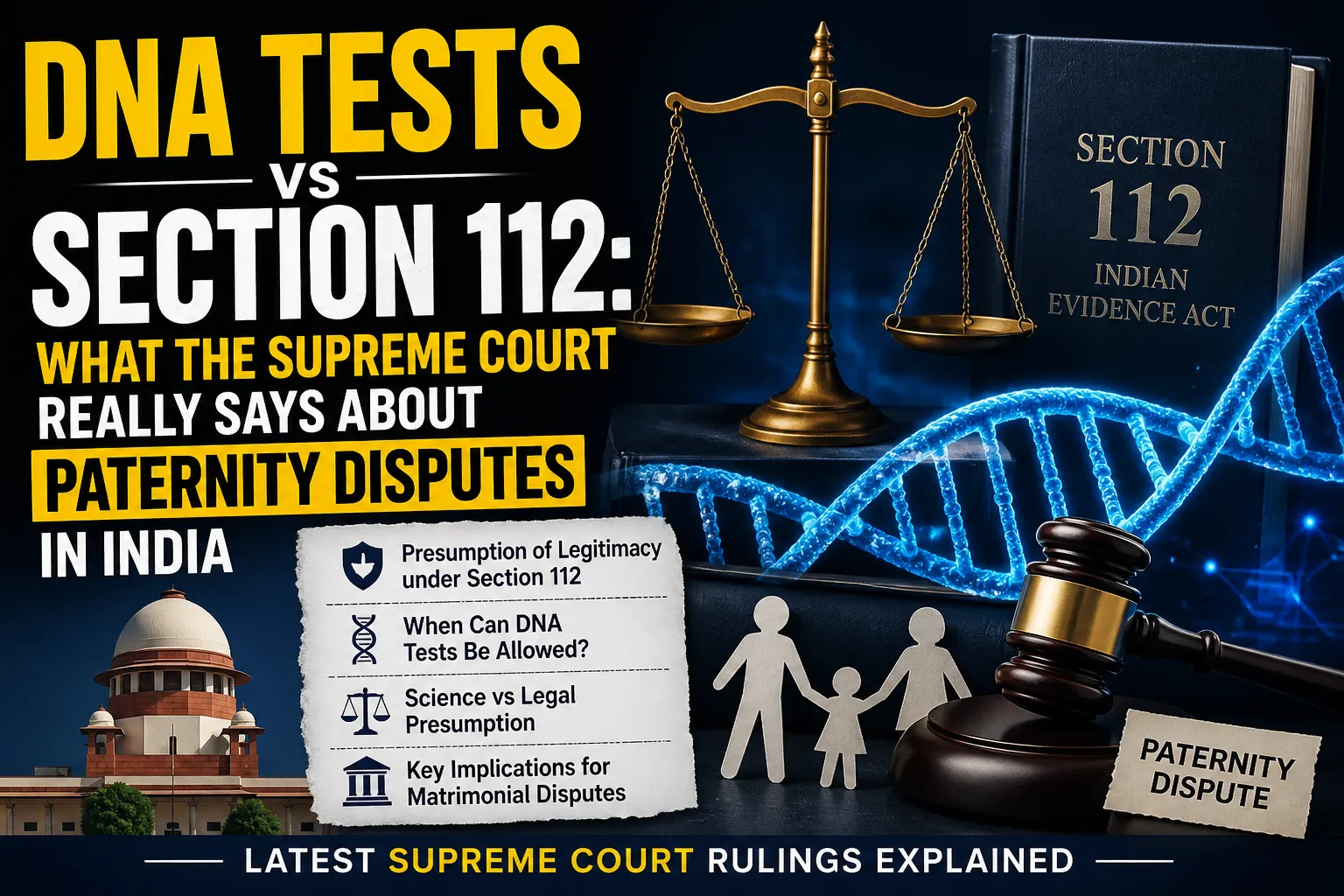
Table of contents
Open Table of contents
Introduction
The law governing the legitimacy of a child and disputes over paternity in India has seen consistent judicial refinement. At the core lies Section 112 of the Indian Evidence Act, 1872 (now reflected in the Bharatiya Sakshya Adhiniyam), which establishes a strong legal presumption in favour of legitimacy for children born within a valid marriage.
Recent Supreme Court developments have sharpened the boundary between legal presumption and scientific intervention, particularly in cases where DNA testing is sought. For any litigant consulting a divorce lawyer in Kolkata, especially in areas like Salt Lake, New Town, and South Kolkata, this evolving position has direct implications on litigation strategy.
Section 112 Explained: Why the Law Protects Legitimacy So Strongly
Section 112 creates a conclusive presumption that a child born during the subsistence of a valid marriage is the legitimate child of the husband, provided there was “access” between the spouses during the time of conception. This is not a mere procedural safeguard—it is a substantive rule designed to protect the child from social stigma and legal uncertainty.
Courts have consistently held that rebutting this presumption is extremely difficult. The only recognised ground is proof of “non-access,” meaning that the parties had no opportunity to cohabit during the relevant period. Mere suspicion or allegations of infidelity are insufficient to displace this presumption.
Supreme Court’s 2025 Position: DNA Testing Is Not Automatic
In its recent rulings, the Supreme Court has made it clear that DNA testing cannot be ordered routinely in paternity disputes. The Court cautioned against the mechanical use of scientific tools in matters involving personal relationships and legitimacy.
The key principles emerging from recent judgments are:
- DNA testing is an exception, not the rule: It should not be used as a tool for speculative litigation.
- The presumption under Section 112 remains dominant: Scientific evidence is not a shortcut to bypass legal protections.
- Dignity and welfare of the child: The court must ensure that such tests are only ordered when absolutely necessary for the resolution of the dispute.
When Will Courts Allow DNA Testing?
While the courts exercise caution, DNA testing is permitted in limited circumstances where strict conditions are satisfied:
- Prima Facie Evidence of Non-Access: There must be strong evidence indicating the spouses could not have had access to each other.
- Necessity for Justice: The test must be essential for resolving a specific legal issue, not for “fishing” purposes.
- Balancing Interests: Courts weigh the potential impact on the child’s psychological and social well-being before granting such requests.
A Subtle Shift: Science vs. Legal Fiction
Recent judicial trends indicate a nuanced shift. While Section 112 governs the threshold stage, courts have acknowledged that conclusive scientific evidence, once validly obtained, may override the statutory presumption.
In situations where DNA testing definitively disproves biological paternity, courts have shown a willingness to accept scientific truth over legal fiction. This has a direct impact on maintenance proceedings, where liability may not be imposed on a person proven not to be the biological father.
Impact on Matrimonial Litigation in Kolkata
Whether the matter is being handled in Salt Lake, New Town, or South Kolkata, the following practical realities now shape litigation:
- Allegations alone are insufficient to challenge paternity.
- Courts are reluctant to permit intrusive testing without strong justification.
- Maintenance claims may be contested where scientific evidence disproves paternity.
- Child welfare remains the central consideration overriding all competing claims.
Conclusion
The Supreme Court’s evolving jurisprudence reflects a careful reconciliation between traditional legal presumptions and modern scientific advancements. For individuals seeking guidance from a divorce lawyer in Kolkata, these developments underline the importance of a well-planned legal approach. Paternity disputes are no longer decided on assumptions—they demand precise evidence and a clear understanding of how courts balance law with science.
Advocate Prithwish Ganguli
House # 73, near Tank #10, (Behind Matri Sadan Hospital),
EE Block, Sector II, Bidhannagar (Salt Lake), Kolkata 700091
M.: 99030 16246