Mental Cruelty as a Ground for Divorce: Evolution of Judicial Trends in India
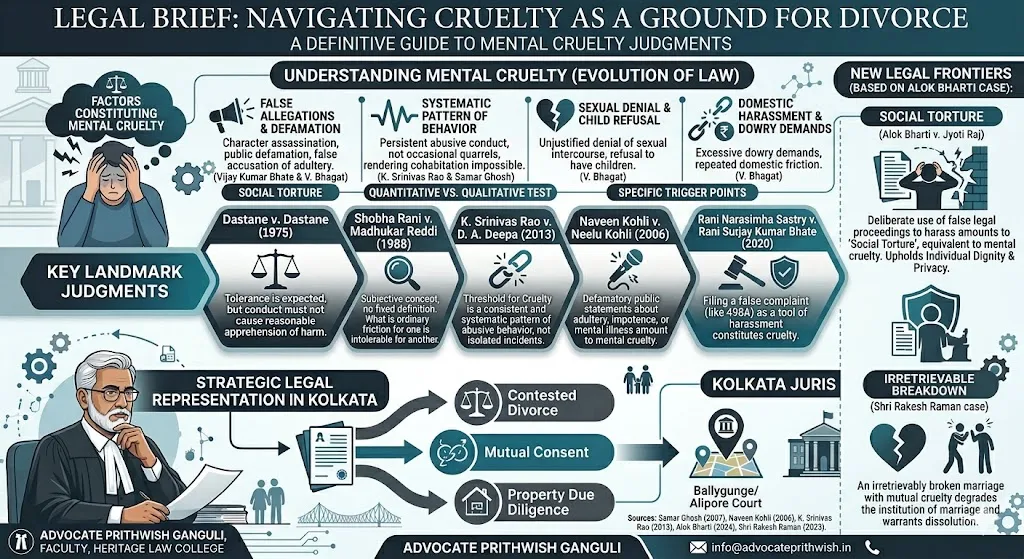
Table of contents
Open Table of contents
- Introduction
- 1. The Foundation: Tolerance and the “Ordinary Wear and Tear”
- 2. The Subjectivity of Pain
- 3. Specific Categories of Mental Agony
- 4. Character Assassination as “Social Torture”
- 5. The Quantitative vs. Qualitative Test
- 6. The Weaponization of the Law
- 7. Irretrievable Breakdown and Mutual Hostility
- Strategic Legal Representation in Kolkata
Introduction
In contemporary Indian jurisprudence, the sanctity of marriage no longer demands the endurance of suffering. As the Supreme Court has evolved, “Cruelty” has shifted from a physical act to a psychological state. For litigants in Kolkata, understanding these precedents is the first step toward reclaiming their right to a life of dignity.
1. The Foundation: Tolerance and the “Ordinary Wear and Tear”
Dastane v. Dastane (AIR 1975 SC 1534)
This case remains the “North Star” for divorce law. The Court established that marriage is built on mutual adjustment. However, it drew a line: when the conduct of one spouse creates a reasonable apprehension in the mind of the other that it is unsafe or injurious to continue the relationship, the legal threshold of cruelty is met.
- Key takeaway: Litigation must distinguish between “petty quarrels” and “substantial cruelty.”
2. The Subjectivity of Pain
Shobha Rani v. Madhukar Reddi (1988) 1 SCC 105
The Court ruled that cruelty is not a “straitjacket” concept. It varies based on social status, education, and cultural environment. What constitutes an intolerable environment for a professional in Ballygunge or a faculty member in Kolkata might be viewed differently in another context.
- Key takeaway: The court assesses the impact on the victim, not just the intent of the perpetrator.
3. Specific Categories of Mental Agony
V. Bhagat v. D. Bhagat (1994) 1 SCC 337
This judgment is critical for identifying non-physical abuse. The Court explicitly recognized:
- Unfounded accusations of infidelity: A grave assault on a spouse’s character.
- Sexual Denial: Unjustified refusal of physical intimacy is a form of cruelty.
- Dowry Pressures: Persistent demands that create emotional distress.
4. Character Assassination as “Social Torture”
Vijay Kumar Ramchandra Bhate v. Neela Vijay Kumar Bhate (2003) 6 SCC 334
The Court highlighted that making “disgusting and unsubstantiated allegations” about a spouse’s chastity in a written statement or during cross-examination is a permanent assault on honor. Once these allegations are made in court, the damage is considered irreparable.
Alok Bharti v. Jyoti Raj (Patna High Court)
This recent perspective adds the layer of Privacy. The Court held that forcing a spouse into false legal battles or making illicit claims about their private life constitutes “social torture,” which is as damaging as any physical blow.
5. The Quantitative vs. Qualitative Test
Samar Ghosh v. Jaya Ghosh (2007) 4 SCC 511
This is perhaps the most cited case in Alipore and Sealdah Courts. The Court listed various instances of mental cruelty, such as a spouse undergoing a unilateral vasectomy/abortion or a total coldness in behavior.
- The Rule: It must be a consistent pattern of behaviour, not a “one-off” incident of anger.
6. The Weaponization of the Law
Rani Narasimha Sastry v. Rani Suneela Rani (2020) 18 SCC 247
In a significant protection for the accused, the Court noted that while filing a case is a legal right, filing a false case (such as under Section 498A) that leads to an acquittal can be treated as mental cruelty against the husband.
7. Irretrievable Breakdown and Mutual Hostility
Shri Rakesh Raman v. Smt. Kavita (2023)
The Court observed that when a marriage has become so acrimonious that both parties are effectively “at war,” the institution of marriage is already dead. Continuing such a union is, in itself, an act of cruelty.
Strategic Legal Representation in Kolkata
For those seeking a Divorce in Kolkata, the choice of counsel is pivotal. A lawyer must not only understand the law but also the specific sensitivities of the Calcutta High Court and District Courts.
Advocate Prithwish Ganguli, with his unique blend of academic insight as a Faculty Member at Heritage Law College and practical experience in Salt Lake (Bidhannagar), offers a sophisticated approach to:
- Mutual Consent Divorce: Ensuring fair alimony and asset division.
- Contested Petitions: Proving mental cruelty through rigorous evidence.
- Property Due Diligence: Safeguarding your financial future post-separation.
Advocate Prithwish Ganguli
House # 73, near Tank #10, behind Matri Sadan Hospital,
EE Block, Sector II, Bidhannagar, Kolkata, West Bengal 700091
M.: 99030 16246