The ‘Mischief’ of Ex-Parte Divorce: How the Jharkhand High Court Saved a Wife’s Right to be Heard
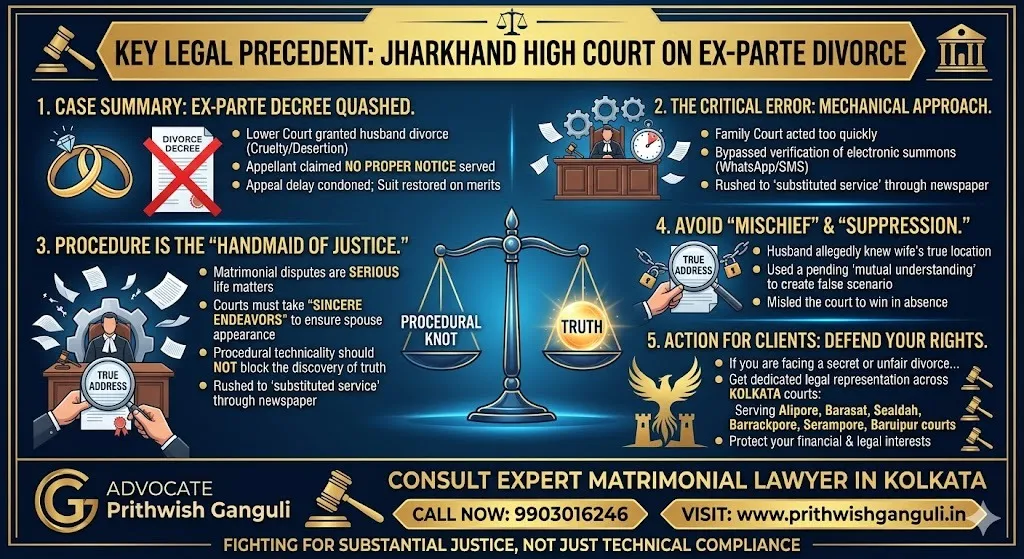
Table of contents
Open Table of contents
Introduction: Procedure is the Handmaid of Justice
In a landmark judgment emphasizing that “procedure is the handmaid of justice,” the Jharkhand High Court recently set aside an ex-parte divorce decree, reinforcing the need for substantial justice in matrimonial disputes. The ruling in Menka Kumari v. Uttam Kumar Das serves as a critical reminder for litigants and legal practitioners in Kolkata, Alipore, and Barasat that mechanical legal shortcuts can lead to a miscarriage of justice.
As a lawyer in Kolkata specializing in matrimonial law, I find this case particularly relevant for clients dealing with ex-parte orders or service of summons issues. If you are starting your legal journey, you might want to read our Step-by-Step Guide on What to do if Your Spouse Files for Divorce in Kolkata.
The Case Background: A “Surprising” Jump to Publication
The appellant, Menka Kumari, challenged a 2024 judgment from the Additional Family Court in Dhanbad, which had granted her husband a divorce on grounds of cruelty and desertion. The husband, Uttam Kumar Das, claimed he had served notices via Speed Post, WhatsApp, and SMS.
However, the High Court noted a “surprising” procedural leap. On the same day the husband filed a postal track report, he petitioned for substituted service (newspaper publication). The lower court allowed this immediately, without verifying electronic delivery or waiting for a formal process server report.
Key Takeaways from the Jharkhand High Court Ruling
1. Matrimonial Disputes are Not Mechanical
The Division Bench, comprising Justice Sujit Narayan Prasad and Justice Sanjay Prasad, emphasized that matrimonial cases affect the entire lives of the parties involved. Courts must avoid a “mechanical approach” and ensure every effort is made to secure the appearance of the spouse.
2. Substituted Service is a Last Resort
The Court highlighted that the Family Judge bypassed critical verification steps. Before resorting to newspaper publication, the court should have made “sincere endeavors,” such as involving the jurisdictional police station to ensure the summons reached the wife.
Read Also: Can Divorce be Filed Without Spouse Consent in India? – A Comprehensive Guide
3. Prevention of “Mischief” and Suppression of Facts
The appellant alleged that her husband suppressed her true residential address and manipulated the situation via a “mutual understanding” bond paper while the suit was pending. The High Court reiterated that procedure should never hamper the discovery of truth.
Why This Matters for Clients in Kolkata, Alipore, and Barasat
If you are facing a divorce in Kolkata or have been served a notice from the Alipore District Court or Barasat Court, understanding your rights regarding the “Service of Summons” is vital.
- The Right to be Heard: You cannot be stripped of your right to defend yourself simply because of a technicality in postal tracking.
- Condonation of Delay: In this case, the High Court condoned a 204-day delay in filing the appeal because the wife was never properly informed of the original suit.
- Restoration of Rights: The High Court quashed the decree and restored the suit, allowing the matter to be heard on its merits.
Need Expert Help? Finding the Best Divorce Lawyer in Kolkata – Complete Guide to Family & Custody Cases
Consult an Expert Divorce Lawyer in Kolkata
Whether you are dealing with an ex-parte decree or need assistance with a contested divorce at the Sealdah, Barrackpore, or Serampore courts, professional legal guidance is indispensable.
If you believe a divorce decree has been obtained against you unfairly or through suppression of facts, contact Advocate Prithwish Ganguli to restore your legal standing and fight for substantial justice.
F.A. No. 74 of 2025 with I.A. No. 2923 of 2025; Menka Kumari vs. Uttam Kumar Das
Advocate Prithwish Ganguli
- Mobile: 9903016246
- Google Profile: View Profile
- Chamber: EE Block, Sector II, Bidhannagar, Kolkata 700091